Showing posts with label International. Show all posts

Friday, 1 July 2011

Venice Biennale 2011 - Roundup


Three weeks after my trip to The Venice Biennale all the little thoughts and the sensory delights are beginning to settle into place. Here is a fragmentary summary of a few of my favourite shows and works.


America's offering Gloria, features work by Jennifer Allora and Guillermo Calzadilla. Every now and again a deep, ominous rumbling and squealing can be heard across the Giardini, in fact it is a piece of performance that takes place at set intervals outside the American Pavilion. An upturned desert tank sits with its massive caterpillar tracks in the air; affixed to them is a running machine on which an olympic athlete, in American colours begins to run. As he does so the tank tracks begin to turn and grind. It's an uneasy sight - surprising and funny, but then the clean-cut perfection of the athlete is uncomfortable - in a Leni Riefenstahl way. The tank makes blunt reference to the war in Iraq and Afghanistan, but it is rendered impotent, animated only by this American fantasy of the strong, healthy, clean-living winner running to go nowhere.

Inside the show two further performances take place. Sculptures of aircraft seating, made by cutting-edge rapid prototyping techniques, stand in the gallery spaces, at regular intervals highly trained gymnasts perform meticulously controlled set pieces using the sculptures. These references to  9-11, these fragments of aeroplane - is this an act of reclamation? Or is it an act of futility? A film in another room shows a series of vertical poles in open landscapes against which more of these superb athletes hoist themselves horizontally like human flags. It is a seriously thought provoking exhibition and has stayed with me nagging at notions of national pride and atrocity.

Hew Locke - Starchitect


Artsway's New Forest Pavilion in Dusoduro showed some memorable work. The venue partners with other galleries in the UK to create residencies and the works on show are the results of these projects. The artists represented this year are: Gayle Chong Kwan, Dave Lewis, Hew Locke, Mike Marshall, Christopher Orr and Sophy Rickett. 

I particularly liked Hew Locke's Starchitect installation which transforms the space into a fantastical grotto of kitsch sculptures constructed from all kinds of cheap treasure and objects. Mike Marshall's beautiful and poetic film piece A Prism Splits Light shows Vietnamese migrant workers picking olives in Cyprus. Christopher Orr's works explore the Romantic and the Sublime in painting utilising a deliberately anachronistic style. Sophy Rickett's The River shows an installation of documentary style film and sound pieces which record an evening spent with people who are waiting to see of the 'Severn Bore' - a little tidal wave that sweeps the Severn River each year, a surprisingly warm and distinctly British gathering.

David Casini


Upstairs from Artsway in the stunning Palazzo Zenobio there a series of five works by artist David Casini, installed in one of the superbly elegant rooms. Casini's delicately constructed sculptures sit underneath glass domes like Victorian specimens, spindly architectural forms grow out of and yet set up a contrast with natural materials such as coral. These delicate little structures have quietly impressed themselves on me and I keep conjuring them in my mind's eye in their exquisite setting.

Hans Op de Beeck - Location 7


One of a Thousand Ways to beat Entropy, supported by the Courtauld Institute shows the work of four artists. I particularly liked the work of Hans Op de Beeck, Location 7 a suburban home has been reconstructed in full detail as an installation, but every object, including the garden which can be seen through the window is made of dark grey concrete, even the rumpled bedsheets are solid. An evocatively sad piece of music plays and a stultifying pathos imbues the scene. It is a remarkable piece of work.

Grayson Perry - The Walthamstow Tapestry


Penelope's Labour:  Weaving words and images is a must-see for anyone at all interested in textiles and especially weave. This beautifully curated show is in the San Giorgio Maggiore Exhibition CentreAlongside the finest historical tapestries and carpets new work, often made on high-tech state of the art looms is on show. You can see Grayson Perry's stunning The Walthamstow Tapestry and Mark Quinn's ultra contemporary weaving which reference flowers and flora. I was utterly fascinated by a delicate yellow silk wrap which had been entirely woven from the spider silk of the Golden Orb spider. This is a sophisticated and beautiful show. There is a lovely catalogue to accompany the show - I'm kicking myself that I didn't invest!

Venice Biennale 2011 - Penelope’s Labour: Weaving Words and Images from ikono tv on Vimeo.


Here is a link to my Flickr set of images from The Biennale.

Thursday, 30 June 2011

Chiharu Shiota - Memory of Books

Chiharu Shiota - Memory of Books


On the opposite side of the canal from the Wales Pavilion at the Venice Biennale in Castello, Haunch of Venison has commissioned Japanese artist Chiharu Shiota to install a site specific work in the Gervasuti Foundation building. A dense web of suspended threads envelope the books which the artist found on site. I've seen Shiota's work many times online so I was delighted to get an opportunity to see a piece in person, especially in such an evocative space. 


Memory of Books: a short film with Chiharu Shiota from Haunch of Venison on Vimeo.

Wednesday, 29 June 2011

Mike Nelson in Venice


One of the things I was really looking forward to at The Venice Biennale was the opportunity to see the work made for The British Pavilion by installation artist, Mike Nelson,  I, Impostor. I queued for an hour and a half as only a few people are allowed in at a time, luckily it was well worth the wait. Nelson has gone to work on the classic interior of the pavilion with incredible attention to detail to alter the building beyond recognition. 

Nelson has taken as his starting point a piece of work he undertook in 2003 for the Istanbul Biennale, The current work re-imagines the former piece and reconstructs it using salvaged materials from the original site and from Venice. He makes parallels between the history and trade function of the two locations. 


It took him and a small team three months to construct the installation. He has created a dark and sleazy interior, a backstreet workshop in a Turkish city. He sets up the space with claustrophobic rooms, stairs and corridors. The first room suggests a workshop perhaps repairing crystal chandeliers...this could just be a front though; as you venture further it starts to feel less legitimate. Dingy, dirty...someone lives here or at least sleeps here. Upstairs there is a workshop strewn with tools, a portable TV hisses white noise, detuned. Corners are stacked with junk machinery and salvaged scrap. 


A darkroom glows red, a forest of developed photographs hang on washing lines drying in the roof. You can smell the chemicals -it feels obsessive...why all these images, why so many? What is being sought or being recorded? Who is the imposter ofthe work's title? This is at the core of Nelson's work - he sets us up with a living, breathing space and invites us to imagine what has happened or what might happen there, we create our own story. His meticulous attention to detail right down to the fixtures and fittings helps us suspend our disbelief. He makes copious reference to films and books to help us recognise the language of suspense and the building narrative.


Sunday, 26 June 2011

Tim Davies @ Venice Biennale


The Welsh Pavilion has found a new home for the 54th Venice Biennale. Having been slightly off the beaten track on Guidecca for previous manifestations it now nestles between the two main exhibition spaces, Arsenale and Giardini at The Ludoteca Santa Maria AusiliatriceCastello. It's a fantastic location and a great space, a 16th Century ex-convent now run as a community centre.

The first artist to occupy this new location for Wales is Swansea based, Tim Davies. Davies was  a popular choice from the proposals submitted for representation and he has produced a solid and cohesive body of work including two new video pieces made especially for the show which directly reference his experience in Venice. Other works are from his portfolio including two video works along with his Bridges series of altered postcards. Davies has worked alongside his long time colleague as curator for this show, Tom Rowland. The curation of the show is subtly evident as remarked on by Dai Smith, Chairman of The Arts Council of Wales, in his opening speech, it has a symphonic quality which gives the work a building rhythm within the architecture.

I have always enjoyed the materiality of Davies work and the meticulous processes he uses in bringing it into being, so I was pleased that the show was not solely focused on video works. Bridges (2009 - 2011) is a series of 60 framed postcards of bridges in different locations, the artist has, by meticulous scratching, isolated each bridge from its landscape in so doing, drawing attention to its function and significance. The collection sits particularly well in Venice with its endless canals and little bridges, something one is only too well aware of when negotiating the labyrinthine streets.

The older works showing are films, Cadet (Running and Parade at Cardiff) 2010 and Cadet (Standing at Aberystwyth) 2006 both of which take the War Memorial and young cadets at Remembrance Day services as their subject in a reflection on the senselessness of losing young lives to war.

Tim Davies - Drift (2010)


The most iconic of the new works is arguably a new piece of work called Drift (2011) the film focuses on Davies hand as he travels along one of Venice's canals gently touching the surface of the water, we can see the reflection of the Venetian buildings, and the intervention of his hand touching the water constantly disturbs the image. It is beautiful, tender and meditative. I was quite enchanted on first viewing, however on subsequent viewings something unsettling began to emerge for me. Partly a little ripple of feminist disquiet - something about the nuances of the action, but also something about dilettantism - especially in the context of Venice as a destination on the Grand Tour. Maybe there is also a comment on the Biennale itself as an event with which visitors interact often quite superficially, seduced by its prestige, pedigree and the romanticism of its location.

The final work in the show is Frari (2011), a film made from collaged stills taken in the bell tower of the Campanile Santa Maria dei Frari. It has a painterly quality as the film builds through semi abstracted images. The soundtrack provides a tension and reminds us of the performative element involved in making the work. Of all the works it is the least didactic, it feels to be more about pure experience.

Tim Davies deserves this opportunity to represent his country and he has made a solid show for this new space which talks about place without tipping into the dangerous territory of sentimentality.

Tuesday, 10 May 2011

Armed Forces - Alex Van Gelder

Alex Van Gelder - seen here


This incredible photograph of Louise Bourgeois' hands was taken by Alex Van Gelder and is part of the current exhibition at the Hauser & Wirth gallery in Zurich. Here is part of the gallery introduction to the show: "Gnarled, sinewy and wrinkled with age, Louise Bourgeois’s hands were fascinating. Her hands are the subjects of portraits taken by the artist Alex Van Gelder, who, at Bourgeois’s invitation, photographed her at her New York townhouse during the last year of her life. The resulting portfolio of eighteen photographic prints will be on display at Hauser & Wirth Zürich from 12 February." The exhibition shows until 14 May.

Wednesday, 26 January 2011

Paul Villinski

Paul Villinski - Consonance - seen here


I have recently discovered the work of American artist Paul Villinski. He has a particular focus on the reclaimed and recycled in his practice. The pieces he has made using found gloves are particularly captivating. The artist finds lost work gloves on the streets and uses hand sewing, gilding or drawing to bring them into a new existence as art. The wing pieces (mostly from the early to mid 1990's) are incredibly striking, but I actually like the quietness and profundity of those with gilded finger tips.

Paul Villinski - Lift - seen here

Thursday, 23 December 2010

Nicole Dextras

Nicole Dextras - Green Shirt - seen here


Thank you to a polar bear's tale for introducing me to the work of Nicole Dextras, I like these textile pieces suspended in ice which seem very pertinent in the middle of the big freeze we are experiencing in the UK this year. Here are some more images.

Tuesday, 16 November 2010

Sandra Winkworth

Sandra Winkworth - Sleeping Beauties - seen here


I met Sandra Winkworth through this blog, and when she came to visit Wales from Australia earlier in the year, she came with a friend to visit Oriel Myrddin Gallery and we had lunch together - I hope I can get over to Oz sometime soon and learn more about the art/craft scene down-under. I like Sandra's work very much, and her latest show, Sleeping Beauties is at Hand Held Gallery in Melbourne. Here's Sandra's gallery information about the show: "Sleeping Beauties focuses on the bird and the unwanted book exploring issues concerning loss and denial. I collect, forage, assemble discarded ephemera and old books then rework them to hold images of bird studyskins sourced from a 19th century collection at the University of Sydney’s Macleay Museum. Here the bird is out of context, outside of nature and perhaps is a reminder of our tenuous connections with the natural world."

Sandra Winkworth - Sleeping Beauties - seen here
Sandra Winkworth - Sleeping Beauties - seen here

Tuesday, 29 June 2010

Seamus Nolan

Seen here

We had a visit at the gallery today from Elizabeth and Siobhan from Wexford Arts Centre in Eire. We were really impressed by their exhibition programme and their lovely space! In particular the venue has shown the work of Irish artist, Seamus Nolan. His to-scale, recycled cardboard Caravan, part of a show called Demense, was installed in the main gallery space in 2007. We also heard about a really interesting project headed up by Seamus Nolan called Hotel Ballymun in which an abandoned high rise was converted into a hotel space in which people could come to stay. The rooms were furnished with the reclaimed furniture left in the building.


Saturday, 5 June 2010

Music for Dogs


Laurie Anderson - Music for Dogs - seen here

Yesterday, musician Laurie Anderson staged a concert outside the Sydney Opera House for dogs. Music for Dogs was especially arranged to suit canine sensibilities and she said it was the fulfilment of an ambition to look up during a concert and find the whole audience composed of dogs. Brilliant!

We had a canine choir here in Wales a couple of years ago, A Song For Swansea Jack, commissioned by Swansea based arts organisation, LOCWS International. Artist, Richard Higlett staged a performance by dogs in memory of the legendary Swansea Jack, a black Labrador who is said to have saved 29 folk from drowning in the sea in the 1930's.


This gives me an opportunity to feature my own lovely dog, Brock who was seen sporting an Adam Ant look at last week's opening of Rhôd in Carmarthenshire after interacting with some of the art. She used to enjoy yodeling along to a little harmonica, or a heartfelt pack howl - but she's really deaf now (possibly a result of her own incessant and anti-social barking habits!).


Brock - photo by Maya Bryden

Tuesday, 18 May 2010

Design Academy Eindhoven


Studio Formafantasma - Autarchy - seen here

We went to London on Monday - first stop - Sotheby's in New Bond Street to see a show curated from the 2009 graduates of the Design Academy Eindhoven. This exceptional academy has been incredibly influential in current design concepts and products. Beautifully curated, displayed and lit, the show used a series of design led questions as catalysts for the work on show. For instance: "Can we use easily available ingredients to produce?" is tackled by Studio Formafantasma in a beautiful range of domestic ware called Autarchy (Vessel).

Other questions included like things : "Where do you like to take a bath?", "Why aren't we using a hot water bottle anymore?", "What kinds of feelings does hair provoke?". One piece I really liked was in response to the question: "How can we make tender the last goodbye to a loved one who has died?", responded to by Roos Kuipers with a beautifully crafted elmwood bier which replaces the harsh physical and emotional idea of the coffin with a softer ritual for saying goodbye.

Thursday, 13 May 2010

Atelier NL


Modern Painters May 2010 - seen here

I used to subscribe to Modern Painters magazine, but I gave it up a while back - it seemed to get less and less relevant to me. This month's cover really tweaked my interest however both the objects shown in the image and the painterly treatment of the shot.

The pots shown here are part of a collection called Drawn from Clay, made by Nadine Sterk and Lonny Van Ryswyck of Atelier NL in the Netherlands, the winners of the inaugural 2010 re:vision Design Award, set up by Modern Painters. The award seeks to address "...the disjunction between our material culture and the resources exploited to support it..." The magazine sees 'design' as the perfect intermediary discipline through which to consider these issues without adopting a "...Luddite attitude toward consumption."

The makers met in 1999 at the Design Academy Eindhoven and after graduation launched Atelier NL in 2006 to pursue their interests in local resources for clay. To make the Drawn from Clay series they studied geological soil maps and set about visiting and seeking the permission of landowners to collect buckets of particular soil types from Dutch regions to make clay. They have discovered 14 clay types from different regions (Polders) of the Netherlands. Nadine Sterk says of the project "What I really like about this material is that so many details, so much history, jump out from a little piece of soil...the surviving brick factories still use natural clay, but they mix it with all different minerals to get the perfect colour"...because of this homogenisation, plus the prevalence of white-glazed porcelain, we tend to forget that ceramics are made of earth or that towns and nations have forged identities through architecture, tools and tableware whose peculiar characteristics owe much to the dirt beneath the inhabitants' feet.' P.65 May edition of Modern Painters

There is a beautiful balance between the rustic simplicity of the form and materials and the contemporary additions of pewter and glass; both elegant and earthy.


Atelier NL - Drawn from Clay - seen here

Thursday, 15 April 2010

Michael Johansson


Michael Johansson
- Strövtåg i tid och rum (Strolls through time and space) - seen here

I like Michael Johansson's work, the obsessive bit of me feels such exquisite satisfaction at the organisation - ahhhh! The junk shop-aholic part of me loves the stuff...


Michael Johansson - Packa Pappas Kappsäck (Pack Daddy's Suitcases) - seen here

Michael Johansson - Vi hade i alla fall tur med vädret, 2006 (At least the weather was nice) - seen here

Michael Johansson - Bleka Minnen, (Faded Memories) - seen here

Tuesday, 23 March 2010

Carolien Broesen


Carolien Broesen - holten - seen here


Carolien Broesen - takken II - seen here

I've also been introduced to Dutch artist Carolien Broesen this week by Hazel Terry at her blog, The Art Room Plant. Constructions made from scaps of nature embedded or secured in various media, they're essentially about pattern and process.

Carolien Broesen - mosell II - seen here

Friday, 15 January 2010

Miss Flite's Birdcages


Fun Is Always In Style - Birdcage - seen here

I found this lovely project today through Flickr. I don't know the artist's name, but on Flickr she is Fun Is Always In Style and is based in California. The series of birdcages use reclaimed domestic objects and relate to the character Miss Flite, in Charles Dickens' Bleak House. Miss Flite is an elderly eccentric whose family has been destroyed by a long-running Chancery legal case through which she expects financial settlement. Somewhat unhinged by her obsessive fascination with the legal process, she owns a large number of little birds in cages which she says will be released "on the day of judgement". The birds have "...allegorical names like Hope, Youth, Beauty & Words, Confusion, Jargon, Plunder, Precedent, Despair, Ruin, Sheepskin, Spinach & Gammon to signify the consumption of all things by fruitless law cases." seen here


Fun Is Always In Style - Birdcage - seen here


Fun Is Always In Style - Birdcage - Seen here

Monday, 11 January 2010

Mario Merz - Arte Povera


Mario Mertz - Untitled, 1998 - seen here

I popped in on my friend Louise Bird today - she's just moved into a new home. Her art books were all on display whilst they had not been so accessible in her old place - my eye kept drifting along the row and eventually I pulled out an Italian catalogue of Arte Povera works. It reminded me how interesting and relevant the movement remains today. I revisited Mario Merz's Igloos and researched a bit more when I got home - here's an obituary from The Guardian from 2003.


Mario Merz - Igloo Nero - Seen here

Tuesday, 8 December 2009

Tacita Dean - Still Life 2009


Tacita Dean - Still Life - seen here

I would have liked to see Tacita Dean's show Still Life at Fondazione Nicola Trussardi in Milan earlier in the year; an ambitious project featuring 14 film works.

I am particularly drawn to a new piece made in 2009, Day for Night for which the artist gained access to the studio of painter Giorgio Morandi in Bologna where he worked for over 50 years. She has filmed the objects, including the bottles and vases that the painter spent his life meticulously studying and reproducing as still life paintings.

Tacita Dean's slow, melancholic style of filming is a perfect vehicle through which to revisit the obsessively particular, pre-minimalist work of Morandi. Her serendipitously random approach however brings a contrasting richness to the rigour and economy of Morandi's original studies.


Giorgio Morandi - Still Life (Natural Morta) - 1953 oil on canvas, 8 x 15-3/4 inches - seen here

Thursday, 5 November 2009

Sara Hubbs


Sara Hubbs - Angle Grind - seen here

Thanks to Abigail Doan for reminding me about American artist Sara Hubbs today. Sara works with old shoes using their inherent sculptural qualities to make new assembled forms: "... I create assemblages from discarded remnants of shoes and other personal ephemera. I investigate the relationship between these forms, and their materials while at the same time, providing these relics with new meaning. I am interested in the play between narrative and form and how it shapes the way we see. Looking to use and accumulation as points of contact with the world, muted and unseen spaces take shape..."


Sara Hubbs - Frequency Radio - seen here
I have often excused the compulsion to buy shoes by claiming them to be wearable sculptures (oh, the indulgence and self delusion!). Of all the personal possessions surely shoes are the most poignant as they mould their substance to our bodies and the nuances of our movement, recording our travels and encounters.


Sara Hubbs - The 4 M's: Material, Movement, Metaphor, Memory - seen here

Wednesday, 28 October 2009

Sandra Winkworth


Sandra Winkworth - Pick Me - seen here

I really like these beautiful book works by Australian artist/print maker Sandra Winkworth. Pick Me is a concertina book of tender drawings showing eight Australian marsupials often overlooked by urban folk. Their imploring eyes look out from the pages which can be arranged in an intense little circle or arranged into a 'leaf litter' pile. Drawn with Biro onto recycled prints and book pages, the piece uses the everyday practice of doodling and sketching on scraps and oddments to draw attention to the everyday wildlife we take for granted.

Another series called Lost and Found uses similar techniques of pen on found papers.


Sandra Winkworth - Lost and Found - seen here

Friday, 2 October 2009

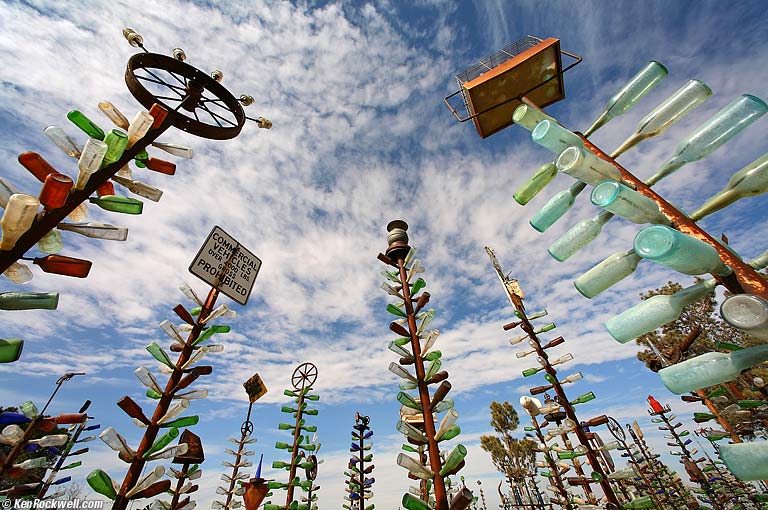
Bottle Tree Ranch


Elmer Long's Bottle Tree Ranch on Route 66, image: Ken Rockwell, seen here

Finding out about Elmer Long's Bottle Tree Ranch this morning has reminded me that this is a wonderful world! A beautiful piece of roadside art. Taking up welding after his retirement, Elmer started his project with his father's bottle collection and it has grown and grown from there. Here's a You Tube piece about him and his creation.

I found this image too, which is a similar project by Winter Zellar (Zero) Swartsel in Ohio.


Winter Zellar (Zero) Swartsel, Bottle Farm - seen here

The Bottle Farm no longer exists, but there is a plaque to mark its location - here's the text:

"A direct descendant of original settlers in Jackson Township, Winter Zellar (Zero) Swartsel was born in 1876. Throughout his life he was a natural born showman, teacher, eccentric, anarchist, and “possibly the grandfather of American Pop Culture.” At a young age and tired of the routines of Farmersville, he declared that, “He would live by his wits while his brothers lived by the sweat of their brows.” He and a friend bicycled first to New York City and then turned around to head west and eventually the world. Later his home would overflow with items collected while traveling the world. Outside was a similar story. While chiding the American people for their wastefulness and abusing their environment, his 22 acres of farmland became his artist's canvas filled with the thousands of items he collected from the “wasteful.”

Winter Zellar (Zero) Swartsel's farm property became a field of glass as he adorned it with sculptures and “art” using glassware of all kinds, bells, bed frames, wood, and other discarded items. His finest works, fashioned from bottles titled “Kindly Light” and “Full Measure” created the popular Farmersville Bottle Farm. The farm also provided interesting listening experiences. In addition to the bells and twinkling glass that rang out in the wind, residents in town could count on hearing “The Old Rugged Cross” played on loud speakers on Sundays. Bells on grazing sheep added to the “noises” he described as restful. The farm attracted visitors from every state in the nation except Delaware. Dying in 1953, Swartsel bequeathed his land to the community to become the Farmersville-Jackson Township Joint Recreation Park to be used for the pleasure of children."