Showing posts with label Folkart. Show all posts

Tuesday, 14 February 2012

Charmed Life: The solace of objects

Felicity Powell - Conjuring Coral - seen here


The Wellcome Collection in London is currently showing an exhibition of charms and amulets, Charmed Life: The solace of objects which is the result of a project with artist, Felicity Powell. Powell has had the opportunity to engage with the museum's collection of 1400 amulets and charms collected in the early twentieth century by folklorist, Edward Lovett. She is also showing her own extraordinary wax drawings and films alongside the collection.

The exhibition publicity uses this insightful quotation from 1580:  “It seems that the soul... loses itself in itself when shaken and disturbed unless given something to grasp on to; and so we must always provide it with an object to butt up against and to act upon.” Michel de Montaigne, 'Essais' 

The exhibition runs until 26 February 2012.

Monday, 25 April 2011

Blue Birdhouse

seen here


Thanks to Jim Linderman on his excellent blog Dull Tool Dim Bulb for posting this birdhouse today,  built 50 years ago in Michigan. I just love the simple, beautiful, functional nature of it.

Monday, 26 July 2010

Button Suit


Ruby Ann Kittner - Button Suit - seen here

Thanks to John Foster on his blog Accidental Mysteries for posting this, it's from the American folk art collection of dealer, Harvey Pranian. It was made circa 1930 -40 by Iowan, Ruby Ann Kittner and is offered for sale along with a photo of the suit being worn by her husband Jake.

Thursday, 25 March 2010

Odd Fellows


The Hastings Jack-in-the-Green - seen here

I've been pondering Nick Cave's Soundsuits and watching him talk with the curator at the Fowler Museum at UCLA in Los Angeles in my earlier post. For me it flags up important issues about the traditions of UK culture too. The idea of the costumed parade is pretty universal but I so often hear people slating our folk traditions; the Morris men et al, but these are our own extraordinary 'soundsuit' traditions. Jeremy Deller and Alan Kane in their 2005 Folk Archive: Contemporary Popular Art from the UK brought the idea of 'popular art' (i.e. people's art) back to the table and posed some interesting and challenging questions about the function of art in our times, and the dislocation many people feel from the institution of art and the 'artworld' (in an Arthur Danto sense) - not least of which being Jeremy Deller's own credentials as a Turner Prize winner.
I remember serendipitously being in Hastings one year during the weekend May Day festival, we had no idea it was happening, we got caught up in the parade and watched the Jack-in-the-Green and his attendants processing down the street. We have many of these fabulous, riotous bizarre traditions in the UK and Ireland; here's a few characters - they fascinate me endlessly.


Y Fari Lwyd (The Mari Lwyd) - Brecon, Wales - seen here

The Padstow Hobby Hoss - Cornwall, England - seen here

The Marshfield Mummers - Gloucestershire, England - seen here


The Burry Man - Queensferry, Scotland - seen here


The Wren Boys - Carrigaline, Ireland - seen here

Friday, 12 March 2010

Fitness for Purpose


Handmade Cobbler's Bench - seen here

I'm really taken with the idea of hybridised and reclaimed objects. I wrote last year about Vladimir Arkhipov's Contemporary Russian Folk Artifacts and Jurgen Bey's Linen-Cupboard-House piece shown at the V & A's Telling Tales exhibition.

Recently I found this picture of a home-made cobbler's bench - perfect functionality - it fits all William Morris' Ruskin inspired criteria of Fitness for purpose that underpinned the Arts and Crafts movement and his famous quote; “Have nothing in your house that you do not know to be useful or believe to be beautiful.”

Friday, 20 November 2009

Ewenny Pottery - Wassail Bowl


Wassail Bowl - Swansea Museum - seen here

I've been thinking about this amazing pot kept in Swansea Museum. It's a wassail bowl made in Ewenny Pottery, south Wales in the mid 19th C. The pottery still thrives and is currently run by 8th generation potter Caitlin Jenkins. Her ancestors first began throwing pots in Ewenny in 1610, but there may have been a working pottery there even earlier as clay was first dug on the site in 1427.

The wassail bowl would have been used as part of a folk custom at Christmas time: "...Wassailing bowls were always decorated in the same way and this one has nearly all the expected traditional features...[the] Christmas tradition of carol singing door-to-door grew out of wassailing. The bowl contained mulled wine which the householder drank for good luck before adding more wine to the bowl." seen here

I have also seen a modern replica made in this style and apparently, it is a difficult thing to produce; this piece manages to have an amazing life and spirit in its making in addition to its virtuosity.
On my recent visit to Flow Gallery in London I saw this piece (below) by Kate Malone which has a strong resonance with the form of the wassail bowl although I don't know if it's intentional.


Kate Malone - seen here

Friday, 2 October 2009

Bottle Tree Ranch


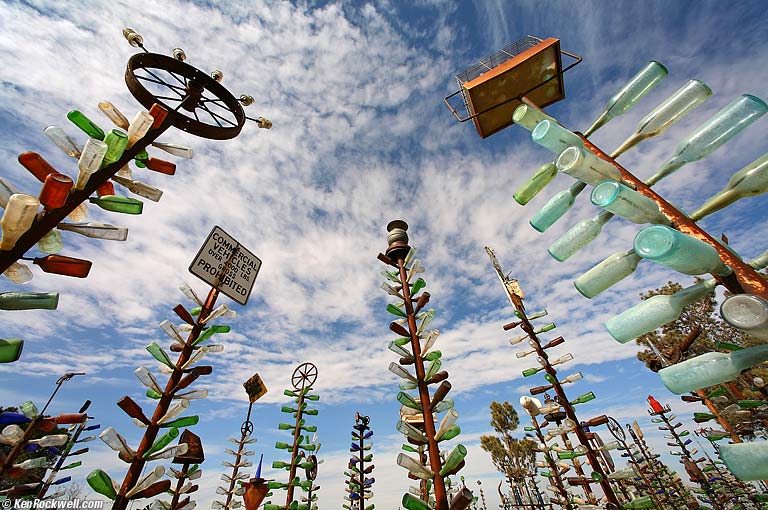
Elmer Long's Bottle Tree Ranch on Route 66, image: Ken Rockwell, seen here

Finding out about Elmer Long's Bottle Tree Ranch this morning has reminded me that this is a wonderful world! A beautiful piece of roadside art. Taking up welding after his retirement, Elmer started his project with his father's bottle collection and it has grown and grown from there. Here's a You Tube piece about him and his creation.

I found this image too, which is a similar project by Winter Zellar (Zero) Swartsel in Ohio.


Winter Zellar (Zero) Swartsel, Bottle Farm - seen here

The Bottle Farm no longer exists, but there is a plaque to mark its location - here's the text:

"A direct descendant of original settlers in Jackson Township, Winter Zellar (Zero) Swartsel was born in 1876. Throughout his life he was a natural born showman, teacher, eccentric, anarchist, and “possibly the grandfather of American Pop Culture.” At a young age and tired of the routines of Farmersville, he declared that, “He would live by his wits while his brothers lived by the sweat of their brows.” He and a friend bicycled first to New York City and then turned around to head west and eventually the world. Later his home would overflow with items collected while traveling the world. Outside was a similar story. While chiding the American people for their wastefulness and abusing their environment, his 22 acres of farmland became his artist's canvas filled with the thousands of items he collected from the “wasteful.”

Winter Zellar (Zero) Swartsel's farm property became a field of glass as he adorned it with sculptures and “art” using glassware of all kinds, bells, bed frames, wood, and other discarded items. His finest works, fashioned from bottles titled “Kindly Light” and “Full Measure” created the popular Farmersville Bottle Farm. The farm also provided interesting listening experiences. In addition to the bells and twinkling glass that rang out in the wind, residents in town could count on hearing “The Old Rugged Cross” played on loud speakers on Sundays. Bells on grazing sheep added to the “noises” he described as restful. The farm attracted visitors from every state in the nation except Delaware. Dying in 1953, Swartsel bequeathed his land to the community to become the Farmersville-Jackson Township Joint Recreation Park to be used for the pleasure of children."

Tuesday, 22 September 2009

Wren House


Wren House made by Richard Cobb in 1869 - seen here
This lovely folk object is kept in St. Fagan's National History Museum near Cardiff. It is a replica made in Pembrokeshire in 1869 as a copy of another house made 60 years before by the same maker. The original was made for the Twelfth Night celebrations of the area. The box would contain the body of a dead wren and would be carried aloft by four men pretending to groan under its weight. It was part of a ritual involving rhyming at village doors to try to gain entry and refreshment.

I have been fascinated by this object for a long time, and made my own little homage to it recently.

Kathryn Campbell Dodd - Wren House 2009

Friday, 14 August 2009

Clootie Wells


Photo: Angus Clyne - Clootie Well at Munlochy, on the Black Isle in Scotland
seen here

In Scotland, clootie means a piece of cloth or strip of rag, it can also mean clothing and cloth for patching. The custom of tying rags to trees and bushes, raggedy bushes, near a well is known across Britain and Ireland. Usually a votive healing ritual - the cloth is dipped in the well and tied to the tree; when the rag rots and falls from the bow, the ailment is cured. There's something strange and atmospheric about the Clootie Well in this image, something slightly spooky but also mournful. It's such a direct intervention. I think it's the simplicity and democracy of the gesture that is compelling to me.

I've been thinking about this for quite a while now. The function and ritual of it, but also the aesthetic. The Mummers plays that are performed around New Year in the UK often include strips of cloth and rags in their costume too.


Mummers performing in Firle in Sussex - seen here

My more recent work has incorporated rag strips and other everyday materials used repetitively.


Kathryn Campbell Dodd - Snowfall 2009

Tuesday, 4 August 2009

The Jen Jones Welsh Quilt Centre, Lampeter Old Town Hall


19th C. flannel quilt from west Wales

I went to the opening of The Jen Jones Welsh Quilt Centre last Friday evening at the converted Town Hall in Lampeter, Ceredigion in west Wales. Having been to the shop run by Jen in Llanybydder recently, I was really interested to see the collection. There were many people there to celebrate the fruition of this long term project which has taken ten years to realise.

The Centre was opened by the Mayor of Lampeter and a short introduction to Jen's collection was given by the V & A textile curator, Sue Pritchard, currently researching and compiling the large show planned at the museum in 2010 Quilts 1700-2010.

The Centre is going to be an astounding addition to west Wales' cultural resources. Jen has over 300 exceptional quilts in her possession many of which will find a home at the Centre.

I was fascinated by many of the single colour pieces, intricately sewn and patterned, but my favourites were the rustic, functional quilts with their imperfections and unusual combinations of colours and textures - many have been rescued from barns and animal sheds where they had been relegated to make way for machine produced newcomers.

I feel excited about the groundswell of interest in textiles in west Wales, along with the National Woolen Museum in Drefach Felindre and the number of working mills such as Rock Mill in Capel Dewi that still produces, there is a strong local tradition and history.

Click here for a BBC news piece about the Centre.

Friday, 31 July 2009

Vladimir Arkhipov....more images


Teapot - Viktor Kuzmichoyov, Moscow 1992

Viktor's daughter recounts the story of dropping her mother's favourite teapot and smashing off the handle. She was completely distraught and cried in the corner until her father came home from work. He calmed his tearful daughter and took the teapot to the factory where he worked and fitted it with a new stainless steel handle. Even though her mother deemed it 'Not aesthetically pleasing...' the teapot continued to be used.


Birdcage - Nikolai Kudelin - Moscow 1994

Nikolai's daughter, Nastya, recounts how her father catches songbirds and keeps them in large cages that he makes himself. This little cage is also hand made to carry the birds around. He often sells the birds or gives them as gifts.


Bubble wand - Oleg Petrischev - Perm,1994

Oleg's granddaughter, Marina, tells how he converted this aluminium spoon for her little brother, Dima. Dima was often entertained by their mother, who worked in a theatre, with fairy tales and impressions of beasts and ogres whilst he was fed which made it easy to encourage him. Sometimes however, he would make a terrible fuss and refuse to eat his food. One day his Grandpa came into the room whilst he was being difficult, stirring something in a mug and banging on the side to attract the little boy's attention. Eventually he pulled out the spoon and began to blow bubbles through the hole he had cut in the bowl of the spoon which fascinated the child. It remains one of Dima's favourite things.


Toy house - Nikolai Ruchkin - Ryazan, 1987

Katya, Nikolai's granddaughter remembers that this little house was made for her brother, Grigorii when he was very ill. He had to spend the weekdays with his grandparents because he was too unwell to go to Nursery school. Katya thinks however, that her Grandad really made the house as much for his own pleasure, making her a bigger version later on.

All images taken from 'Home-made: Contemporary Russian Folk Artifacts' Vladimir Arkhipov.

Saturday, 25 July 2009

Vladimir Arkhipov's folk artifacts


Anatoly Yamanov - home-made chair
from Home -Made: Contemporary Russian Folk Artifacts

A couple of months ago, I found a book about the collection of Russian artist Vladimir Arkhipov called Home-Made: Contemporary Russian Folk Artifacts. The book is a document of a selection from the thousand or so pieces he has collected as part of his project. The objects are made by ordinary people in their day-to-day lives to fulfil a practical necessity. During the collapse of the Soviet Union impoverished people did what people do universally when they need to solve a problem, they adapted the materials at hand to the task. The results are ingenious, resourceful, inventive and unique.
Here is the artist talking about his collection:
"In the Russian language the word for 'creative work' (tvorchestvo) shares a root with the word for "Creator' (Tvorets). The word for 'art' (iskusstvo) shares a root with the word for 'Tempter' (Isskusitel). Formerly, when artists still believed in God, they 'Created'. Today, when most artists do not believe in anything, they make art. There is no creation left in art. So what is an honest artist to do? I have found a partial answer to that question. Since I require a viewer and I am doomed to self-conscious aesthetic reflection, I cannot be absolutely honest and sincere. But I know that every day hundreds of millions of people discover their connection with God in some way when they create. The act of creation has no need of justification. It is self-sufficient. The most interesting visual traces left by creation are those that have not been subject to conscious aesthetic assessment by their creators. All that is required is to find them and present them in a skillful manner. The right of choice is mine. I spent a long time searching for and selecting a modern folk phenomenon (which as yet has no name), as an example: millions of people throughout the world create unique everyday items for themselves. I interview them, take photographs, show their things in exhibitions. In this way, I combine their creative work with my art". P.303
I love this book for many reasons. The objects themselves are wonderful; extraordinary; but so is the documentation. Arkhipov attributes each item with the name and photograph of its 'creator' (unless they have been withheld) and also a story from the maker about the circumstances that brought it into being. The narrative context immediately animates the object and deepens its meanings.
I empathise deeply with Arkhipov's dilemma as an artist, the struggle with 'honesty' for which he has found his expression, the problems of aesthetic irony. I admire his approach greatly but I find my own solutions must involve making.
The chair above was made by Anatoly Yamanov from the Ryazansk region in 1993. His photograph shows a kind faced older man in a check shirt and a flat cap. Sacked without a pension from his job as a plumber he and his wife sold their town flat and moved to a village in the country to live a modest self-sufficient life. "...We bought a small house, but it's got a stove. Without a stove you can't survive the winter. That's the main thing. There was no furniture at all, so I made the most essential things: a table, a bed, some chairs, out of anything I could find lying around". P.276
Arkhipov continues the reach of his project through his Folk Forum website where anyone is free to post examples of hand-made objects.