Friday, 18 March 2011

Gilding the Lily at Transition Gallery

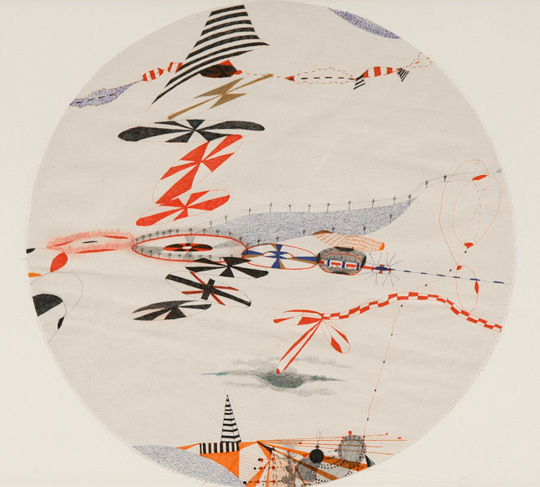
Jessica Holmes - seen here


I'll probably miss Gilding the Lily at Transition Gallery in east London, but it looks really interesting. I like the concept of the exhibition, it is a question that probably all artists - maybe all creatives - have to confront in their own practice. Here's the gallery publicity for the show: 

'To gild refined gold, to paint the lily,
is wasteful and ridiculous excess.' 
Shakespeare

 If making art is in part an act of embellishment, one critique could be whether the embellishment is adding something new, deepening our view or whether it is just excess with no additional value. The word embellishment has a range of meanings, from making beautiful, improving, adding fictitious details, to wasteful exaggeration. This range indicates its slippery subjectivity, depending on the eye of the beholder.

Even the most austere understated artist is an embellisher of sorts as nothing can be stripped away completely as there is always a fiction and pleasure at the heart of every artwork. The pleasure of making and of viewing would arise from the embellishing of ideas and materials, and whether or not the embellishment has become alchemic.


Each work requires a different strategy to achieve this act of embellishment. Some artists may explore ideas and materials through excess and opulence, others by pairing down. The artists in this show reflect this arc.

The show includes the work of Max Hymes, Jessica Holmes, Richard Livingston, Stuart Mayes, Will Tuck, Paul Westcombe, Laura White, Nicola Williams and runs from 19 March to 10 April 2011.

Sunday, 13 March 2011

Make Room

Sarah Rees - Das Unheimliche - seen here


I popped along to the opening of Make Room at Milkwood Gallery in Cardiff last night, one in a series of shows in the capital celebrating International Women's Day. Milkwood Gallery, both a lovely shop stocking vintage and contemporary design and a gallery, are doing good things with their space in Roath, including giving artists a residency space in their ongoing Basement Project.

I particularly liked this piece by Cardiff based Sara Rees made as part of a project with The Welsh School of Architectural Glass in Swansea in conjunction with The Leverhulme Trust. Her artist profile for the show states her themes as "...late-capitalism, psychology and the environment...an on-going exploration of the interface between nature and civilisation." Placed on the floor inside an under stairs cupboard the work explores Freud's theme of the uncanny - the un-homely house; the piece is lit from within to reveal a tangle of plant life within its sleek glass form.

Friday, 11 March 2011

The Jerwood Drawing Prize


Lindsay Sekulowicz - Mid-autumn tiger


The Jerwood Drawing Prize is now open at Oriel Myrddin Gallery, it's very exciting to have this prestigious show here in Carmarthen. The selection is incredibly varied, the natural reaction whilst looking at the works is to chose your favourite, and we have set up a box where you can do just that. It's a tough choice, and I have a feeling my allegiances will change over the duration of the show, but at the moment I like this small drawing by Lindsay Sekulowicz...but I also like the tea table by Cadi Froehlich...

Here's a link to the catalogue.

Cadi Froehlich - Untitled (tea table) - seen here

Thursday, 3 March 2011

Jerwood Drawing Prize

Sian Conti & Meg Anthony musing over the hang for the Jerwood Drawing Prize


We'll be opening the Jerwood Drawing Prize show, which is touring to Oriel Myrddin Gallery this Saturday (2pm), I've been watching everything going up on the walls this week and there are some really interesting works involved. I have a few personal favourites including the winning piece Bolus-Space (Signal) by Virginia Verran. Watch this space for more on the show...

Virginia Verran - Bolus-Space (signal) - seen here

Saturday, 26 February 2011

Artemisia


I went to the opening of Artemesia, a group show (in which I have two new works showing) last night. Curated by Ruth Cayford, the show is at St David's Hall Gallery in Cardiff and features the work of over 40 contemporary women artists currently practicing in Wales, celebrating the ideas they have in 2011. Here is the essay written for the show by Sue Griffith, Head of School of Contextual Studies & Fine Art, Swansea Metropolitan University.

"Maybe the existing forms of art for the ideas men have had are inadequate for the ideas women have."' Susana Torre, 1976

Artemisia Gentileschi lends her name to this extensive exhibition, which brings together the work of numerous women artists currently active in Wales. She was not only an extraordinary Renaissance artist, but also occupied a key role in the recovery of women artists’ history begun by feminists around forty years ago, who sifted through centuries of neglect, not only to uncover forgotten women artists, but perhaps more importantly, they identified shared expressions for the women artists yet to come.

Art’s forms and content have not been without issues for women artists, since both had been defined by male artists. It took a further ideological leap for women to shift from battling with exclusion to a positive questioning of approaches to creativity, emerging from a wish to express their differences, differently. That women might re-define art’s practice by exploring what had hitherto been invisible or defined as ‘not art’, produced some provocative work. Stylistic innovation was perhaps not the most important of these differences, the ‘ideas that women have’ most certainly was. It became clear that historical frictions bound in to the two roles - woman and artist - presented them with unique challenges. What has become clearer now, is that these challenges have enriched their work.

Women’s greater participation in art has transformed art, flipping the subtly nuanced labels sometimes used to relegate their work to obscurity in the Fine Arts (charming, decorative, domestic) entirely on their heads. Refusing hierarchies, they have explored (using that old feminist adage) the personal with the political, intimacy with the allegorical, sensitivity with edginess, the fragile with the dark, fantasy with fetish. In short their creative strategies are as diverse and multi-textured as women themselves, and are abundantly evidenced in this exhibition.

The complexity of human relationships, including self-identity, is navigated through memory and fantasy, and is just as likely to be intensely personal as it is universally symbolic. Desires for connection are also explored through responses to place or location, and might reference the landscape of history, or even pre-history, or the personal space of the domestic. The body, that well contested area, is still of immense importance to a number of the artists here, particularly evidenced through performance based art; its potential for ritual significance seems endless. Drawing is clearly immensely valued as a visualising tool, but no more so than stitching, printing, constructing, photographing, filming and mark making from the fragile to the urgent.

But never forget that whilst our recognition of the ideas and creativity which women have brought to art may seem a recent understanding, in truth Artemisia was already there; it is recognised that her intense portrayal of powerful women differed from interpretations by her male peers. The contest we now face, in a time when arts education is seriously threatened, is that of ensuring that the gains women artists have made in the past forty years are never underestimated and continue to influence art. This exhibition is a timely reminder that Artemisia’s legacy needs to be wholeheartedly celebrated.

The exhibition Features works from:

Sue Williams, Rozanne Hawksley, Catrin Webster, Di Setch, Dilys Jackson, Virginia Head, Rebecca Spooner, Adele Vye, Fern Thomas, Amanda Roderick, Gemma Copp, Anna Barrett, Jacqueline Alkema, Corrie Chiswell, Becky Adams, Susan Adams, Kathryn Ashhill, Kathryn Campbell Dodd, Heather Eastes, Annie Giles Hobbs, Ruth Harries, Penny Hallas, Mary Husted, Daphne Hurn, Ann Jordon, Tiff Oben, Luned Rhys Parri, Jane Taylor, Miranda Whall, Dawn Woolley, Sue Hunt, Rebecca Gould, Eirian Llwyd, Lisa Jones, Nicola O’Neill, Ruth McLees, Bella Kerr, Helen Booth, Jean Walcot, Jo Alexander, Wendy Couling, Su Roberts, Janet Walters and Lisa Tann.

Artemesia continues until April 9th.

Nam June Paik at Tate Liverpool

Nam June Paik - Buddha - seen here


I went to Liverpool this week for the first time, I've been meaning to go there for such a long time. What a beautiful city. The reason for my visit was the Nam June Paik show at Tate Liverpool and FACT

This retrospective show of the Korean/American artist, who died in 2006, is large and comprehensive, showing key works from his career along side documentation, photographs and film. Paik was a member of the Fluxus movement of artists, having met the influential artist John Cage in 1958 (he called the period before this meeting BC - Before Cage). A classically trained pianist, Paik studied at The University of Tokyo and wrote his thesis on the composer Arnold Shoenberg. Later, whilst studying in Germany he met Cage, Karlheinz Stockhausen and Joseph Beuys.

The show includes many of Paik's television based pieces, he understood very early in his career the potential influence of television on culture and is credited with being the first video artist and a pre-curser to the MTV generation. Experimental, funny, ridiculous and pioneering, he plays with the medium and its possibilities. Music is central to his work, and his collaborations with cellist and muse Charlotte Moorman are pure Fluxus madness.

Paik's agenda throughout his career was to humanise technology, make parallels between TV, music, performance and human physiognomy. He was interested in the the conversation between technology and nature and the human spirit. My favourite works in the show were a room of his Buddha television pieces. I felt these pieces had a depth and relevance that held true, they lightly parody the TV generation.  Buddha figures stare contemplatively at CCTV of themselves or empty TV shells sometimes lit with a candle, sometimes meditative, sometimes laughing.

Fluxus is still exerting its influence on current art practice, we are beginning to contextualise its impact more thoroughly. This show raises all sorts of uncomfortable thoughts. It is very hard to encounter the works as anything other than archaic, although their original manifestations were as cutting edge works using the new technology of the era; it is almost impossible not to overlay the sense of the museum on the work. The necessary curation of the work in the Tate space brings a quite sad element to the experience. Most of the pieces were made to be performed, to be part of a happening and definitely not made to be on plinths and under Perspex preserved for our scrutiny. The Fluxus manifesto is diametrically opposed to this show, and in this sense it points to the failure of the revolution it was meant to embody. It doesn't come much more corporate than Tate, and the gallery shop with its Paik merchandise is its testament. I made my own little unintentional 'action' at the till whilst paying for a postcard by managing to knock a box of Tate badges flying scattershot across the floor...embarrassing, but somehow right.

Fluxus Manifesto - seen here


Tacita Dean at Tate Modern

Tacita Dean - From Prisoner Pair - seen here


I'm really excited that Tacita Dean has been chosen as the next artist for the Unilever series in the Turbine Hall at Tate Modern, the work will be installed this October.